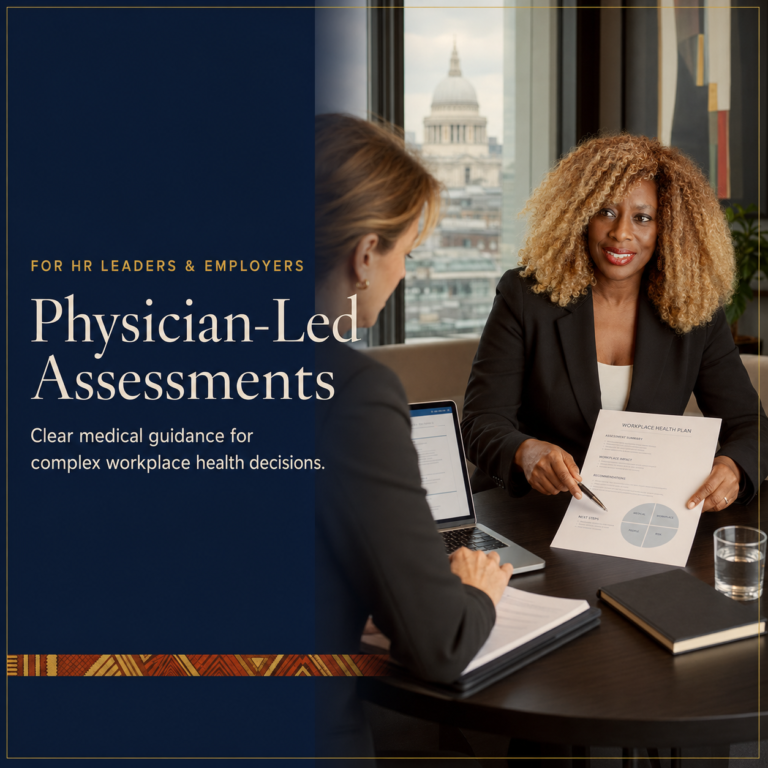
Physician-Led Occupational Assessments
Confidential & Independent
Discreet occupational health guidance for executives, senior leaders and employers.
Personally Physician-Led
Suitable cases are reviewed and managed directly by Dr Abeyna.
Role-Specific Advice
Recommendations reflect the executive role, workplace risks and organisational context.
Physician-Led Occupational Health Assessment London
When the health of a CEO, founder or senior leader becomes a workplace concern, a routine referral process may not provide the depth of clinical judgement the organisation needs.
Dr Abeyna provides a discreet, physician-led occupational health assessment in London for organisations managing complex or sensitive leadership health situations. The service is designed for HR Directors, People Directors, boards, legal and risk professionals, CEOs and senior leadership teams that require clear, independent medical guidance.
Every suitable case is reviewed and managed personally by Dr Abeyna Jones, a Consultant Occupational Health Physician with nearly two decades of experience.
The assessment considers the executive’s health, the demands of their role, workplace risks and the wider organisational context. Its purpose is to help all parties make informed, proportionate and medically sound decisions.
Learn more about Dr Abeyna’s consultant-led occupational health practice in London.
Leadership health concerns can create uncertainty far beyond an individual’s immediate symptoms or absence.
The organisation may need to protect the executive’s health while also considering governance, operational resilience, workforce confidence and leadership continuity. An independent occupational health physician can help clarify the medical and workplace factors that should inform the next decision.
Common referral situations include:
- A CEO, founder or senior executive experiencing a significant health crisis
- Stress, burnout, fatigue or health-related absence
- Uncertainty about whether a senior leader is fit to work
- A planned or proposed return to executive responsibilities
- Concerns about capability, performance or reliability linked to health
- A health condition affecting a safety-critical or high-responsibility role
- The need for an independent medical opinion
- Consideration of reasonable workplace adjustments
- A pre-employment assessment for a senior leadership candidate
- Long-term absence involving a board member or key decision-maker
- Ill-health retirement or pension-related decisions
- A complex case involving legal, employment or reputational risk
- A need for a second occupational health opinion
- An occupational health assessment does not replace emergency care, primary care or specialist medical treatment. It provides an independent medical view of how health may affect work and how work may affect health.
Discuss a Complex Executive Health Situation
Sensitive leadership cases often benefit from early, senior-level clinical input. Submit a confidential application to outline the situation and the guidance your organisation requires.
Why Standard Occupational Health May Be Insufficient
Most general occupational health services are structured to process a high volume of routine employee referrals. That model may be appropriate for straightforward absence management, but complex leadership cases often require a different level of attention.
A senior executive’s role may involve:
- Significant regulatory or fiduciary responsibilities
- High-stakes strategic decisions
- Extensive travel or demanding working patterns
- Responsibility for employees, clients or public safety
- Continuous scrutiny from investors, employees or other stakeholders
- Limited scope to reduce responsibilities without affecting the organisation
- Confidential medical, legal and reputational considerations
- A standard report may answer whether an employee is fit or unfit for work. In an executive case, the organisation may also need to understand what fitness means in relation to the actual demands of the leadership role.
- There may be questions about decision-making capacity, stamina, working hours, travel, public-facing duties, phased recovery, governance arrangements or temporary delegation of responsibilities.
- Dr Abeyna’s approach combines occupational medicine with an understanding of executive roles and high-pressure organisational environments. Recommendations are considered in the context of the individual, the workplace and the organisation that depends on their leadership.
What the Occupational Health Assessment Involves
The scope of each assessment depends on the referral questions and the complexity of the case.
Before an assessment takes place, Dr Abeyna personally reviews the application to determine whether the service is suitable. Relevant information may then be requested so the assessment can focus on the decisions the organisation needs to make.
The process may involve:
Review of the Organisational Referral
The referral should explain the workplace situation, the executive’s role and the questions requiring an independent medical opinion.
Clear referral questions help ensure that the resulting advice is relevant, proportionate and useful to decision-makers.
Confidential Consultation with the Executive
Dr Abeyna meets with the executive to understand their health circumstances, current functional capacity, treatment or rehabilitation position, workplace demands and concerns about work.
The consultation is clinically led and conducted with respect for the executive’s privacy and professional standing.
Consideration of Role Demands
Executive fitness for work cannot be assessed in isolation from the role itself.
The assessment may consider working hours, travel, decision-making demands, regulatory responsibilities, stakeholder exposure, workload, leadership pressure and other material features of the position.
Review of Relevant Medical Information
Where appropriate and with the necessary consent, relevant medical information may be considered to support an informed occupational health opinion.
Only information necessary for the stated occupational purpose should be requested or disclosed.
Independent Occupational Health Advice
Dr Abeyna considers the available clinical and workplace information before providing physician-led recommendations.
The advice is tailored to the questions raised by the organisation rather than generated from a standardised template.
What Your Organisation Can Expect to Receive
The precise output will depend on the referral, the executive’s consent and the information available.
Where appropriate, the organisation may receive clear advice on:
- Current fitness for work
- Functional effects that may be relevant to the role
- Whether a return to work appears medically appropriate
- The structure of a phased or supported return
- Temporary or longer-term workplace adjustments
- Restrictions relating to travel, hours or particular responsibilities
- Further medical evidence or review that may be required
- Likely barriers to a safe and sustainable return
- Whether additional rehabilitation support should be considered
- Review points for reassessing fitness or adjustments
- Relevant occupational health considerations for capability processes
- Leadership continuity and workplace risk considerations
- Whether specialist occupational health follow-up is advisable
- The organisation receives an independent medical opinion, not a management decision. Employment, legal and governance decisions remain the responsibility of the organisation and its advisers.
Benefits for the Executive and the Organisation
A well-structured executive health assessment can reduce uncertainty and support decisions that are fair to the individual and responsible for the organisation.
For the Executive
The assessment provides an opportunity to discuss the relationship between health and work with an experienced occupational health physician.
Potential benefits include:
- A confidential and clinically informed discussion
- Recommendations grounded in the actual demands of the role
- A safer approach to remaining at work or returning after absence
- Appropriate consideration of workplace adjustments
- Reduced pressure to return before it is medically appropriate
- A clearer framework for recovery and rehabilitation
- Greater confidence about expectations and next steps
For the Organisation
The organisation receives independent guidance that can support proportionate workplace decisions.
Potential benefits include:
- Greater clarity about fitness for work
- Better-informed return-to-work planning
- Early identification of relevant workplace risks
- A defensible and clinically reasoned decision-making process
- Appropriate support for reasonable adjustments
- Improved coordination between HR, leadership and medical stakeholders
- Reduced uncertainty around leadership continuity
- A clearer distinction between medical advice and management responsibility
- The objective is not to guarantee a particular medical or business outcome. It is to help the organisation proceed with greater clinical clarity, appropriate safeguards and a realistic understanding of the situation.
Why Organisations Choose Dr Abeyna
Every Suitable Case Is Managed Personally
Dr Abeyna does not delegate suitable executive cases through a high-volume clinical network. Applications are reviewed personally, and accepted cases are managed directly by her.
This creates continuity from the initial review through to the assessment and recommendations.
Consultant Occupational Health Physician
Dr Abeyna Jones is a Consultant Occupational Health Physician with nearly two decades of experience.
Her advice is grounded in occupational medicine and focuses on the practical relationship between health, functional capacity and work.
Executive and Organisational Understanding
Executive health cases involve more than medical facts. Leadership structure, governance, operational responsibilities and stakeholder expectations may all affect what a safe workplace plan looks like.
Dr Abeyna has experience consulting with global organisations across different sectors and understands the pressures associated with demanding leadership environments.
She is also the founder of Medic Footprints, a global platform connecting more than 120,000 doctors with national and international companies.
Professional Memberships
Dr Abeyna is a member of the Society of Occupational Medicine and the Faculty of Occupational Medicine.
Selective and Highly Personalised
This is not a routine employee occupational health service or a general wellbeing programme.
The practice is intentionally selective and is designed for organisations seeking discreet, senior-level medical judgement in complex or high-stakes situations.
Clinically Sound and Commercially Aware
Recommendations consider the executive’s recovery alongside the needs of the workplace.
The aim is to support safe participation in work, realistic rehabilitation, leadership stability and organisational continuity without compromising independent clinical judgement.
Request physician-led occupational health guidance by submitting a confidential application.
How the Process Works
1. Apply Confidentially
Complete a confidential application explaining the executive health situation, the organisational context and the questions requiring guidance.
Applications may be submitted by an authorised organisational decision-maker or professional adviser.
2. Personal Review by Dr Abeyna
Dr Abeyna personally reviews the application to assess whether the matter falls within the scope of the practice.
Not every applicant will be accepted. Suitable applicants may be invited to continue to an advisory call or assessment.
3. Confidential Advisory Call or Assessment
The next step may involve an initial advisory discussion with the referring organisation, a clinical occupational health assessment with the executive, or both.
The scope will be agreed according to the referral questions and the nature of the case.
4. Strategic Physician-Led Recommendations
Following the assessment, Dr Abeyna provides independent occupational health guidance relevant to the executive, their role and the organisational circumstances.
Recommendations may address fitness for work, workplace adjustments, rehabilitation, risk management, review arrangements or return-to-work planning.
Confidentiality in Executive Occupational Health
Confidentiality is central to the service.
Medical information disclosed during an occupational health assessment is handled as confidential clinical information. The executive should understand the purpose of the assessment, the nature of the referral and how relevant occupational advice may be communicated.
The organisation does not automatically receive a detailed medical history. Advice should focus on information relevant to work, such as functional capacity, fitness for role, workplace restrictions, adjustments and recommended review arrangements.
The information disclosed will depend on the circumstances, the occupational purpose and the appropriate consent process.
For organisations, confidentiality also requires careful internal handling. Reports and recommendations should be shared only with people who have a legitimate role in the relevant workplace decision.
Where a case involves employment law, regulatory duties or governance issues, the organisation may also need advice from its legal or professional advisers.
Anonymised Executive Return-to-Work Example
A senior executive stepped away from work following a significant health crisis.
The organisation faced uncertainty about leadership continuity and whether a return to executive-level work would be realistic. The case required experienced occupational medicine, executive workplace strategy, rehabilitation support and careful return-to-work planning.
Three months later, the executive returned to the boardroom with greater clarity, confidence and stability.
This example illustrates why complex leadership cases may require more than a standard assessment. The medical position, functional demands of the role and wider organisational context all needed to be considered together.
Individual circumstances and outcomes vary. No particular result can be guaranteed.
Fees
Fees are discussed after the initial application has been reviewed and will depend on the nature and complexity of the case.
Apply for an Occupational Health Assessment in London
Complex leadership health situations require careful clinical judgement, not a standardised referral process.
Dr Abeyna provides discreet, independent and physician-led occupational health assessments for organisations managing sensitive executive health, fitness-for-work and return-to-work decisions in London and across the UK.
Every application is reviewed personally. Suitable applicants may be invited to a confidential advisory call to discuss the situation and determine the appropriate next step.

Fitness for Work
Independent assessment of current fitness, functional effects and role requirements.

Workplace Adjustments
Clinically appropriate temporary or longer-term adjustments.

Return-to-Work Planning
Structured, supported and sustainable executive return-to-work recommendations.

Complex Case Management
Senior clinical input for sensitive or high-stakes workplace health situations.

Independent Medical Opinion
Clear physician-led reporting tailored to the organisation’s referral questions.

Leadership Continuity
Occupational health guidance that considers risk, rehabilitation and organisational stability.
Frequently Asked Questions
What is an occupational health assessment?
An occupational health assessment is an independent medical evaluation of the relationship between a person’s health and their work.
It may help an employer understand whether an individual is fit for their role, whether adjustments should be considered and what support may assist a safe return to work.
It does not replace the individual’s GP, treating consultant or emergency medical services.
Who is this occupational health assessment in London for?
The service is primarily designed for CEOs, founders, board members, senior executives and leadership candidates.
Referrals are usually made by organisations, HR or People Directors, boards, legal and risk professionals, or other authorised decision-makers managing a complex workplace health situation.
Does Dr Abeyna assess employees at every level?
The practice specialises in executive and senior leadership health.
It is not a high-volume occupational health provider for routine workforce referrals. Applications are reviewed to determine whether the case is appropriate for Dr Abeyna’s selective physician-led service.
Can the assessment provide an opinion on fitness for work?
Yes, where this is an appropriate referral question and sufficient information is available.
The opinion may consider whether the executive is fit for their full role, may be fit with restrictions or adjustments, or is not currently fit for work. The advice may also recommend review arrangements.
Can Dr Abeyna advise on workplace adjustments?
Yes. Recommendations may include temporary or longer-term workplace adjustments where these are clinically appropriate and relevant to the executive’s functional capacity.
The organisation remains responsible for deciding whether and how recommendations can reasonably be implemented.
Can the service support a senior executive returning after illness?
Yes. The assessment can inform executive return-to-work planning after a physical or mental health condition, significant health crisis or extended absence.
Advice may address timing, phased duties, workload, travel, hours, decision-making responsibilities, rehabilitation and review points.
Does the service cover stress, fatigue and burnout?
These concerns may fall within the scope of an executive occupational health assessment, particularly where they affect attendance, functioning, performance or fitness for role.
The service is not counselling or a general wellbeing programme. Its focus is the relationship between health, work demands and safe workplace decisions.
Can the assessment support pre-employment decisions?
Dr Abeyna may provide occupational health assessments for senior leadership candidates where there is a legitimate occupational purpose.
The assessment should focus on fitness for the proposed role and relevant workplace considerations. It should not be used to make assumptions about a candidate based on diagnosis alone.
Can you provide a second occupational health opinion?
A second opinion may be considered where an organisation requires further specialist input into a complex executive case.
The application should explain the advice already received, the unresolved questions and why an additional opinion is being requested.
Will the employer receive the executive’s full medical information?
Not automatically.
Occupational health reporting should focus on information relevant to the workplace decision. This may include functional effects, fitness for work, restrictions, adjustments and review recommendations rather than an unnecessary account of the individual’s full medical history.
Can the assessment be used for capability or ill-health retirement decisions?
These matters may fall within the scope of occupational health advice, depending on the case and the questions being asked.
The medical assessment provides an independent clinical opinion. The organisation remains responsible for employment, pension, legal and procedural decisions.
Does Dr Abeyna provide occupational health assessments outside London?
Dr Abeyna sees suitable clients at her occupational medicine practice in Marylebone, London and supports organisations across the UK.
The format and suitability of an assessment will depend on the circumstances of the case and will be considered after the confidential application has been reviewed.
How quickly can an assessment be arranged?
No standard appointment availability or turnaround time is promised.
Applications are reviewed personally by Dr Abeyna. The next steps will depend on suitability, urgency, scope and the information required.
How much does an executive occupational health assessment cost?
Fees are discussed after the initial application has been reviewed and will depend on the nature and complexity of the case.
How do we refer a senior leader?
Submit a confidential application outlining the situation, the executive’s role, the organisation’s concerns and the questions requiring physician-led advice.
Suitable applicants may then be invited to an advisory call with Dr Abeyna.