Retained Advisory
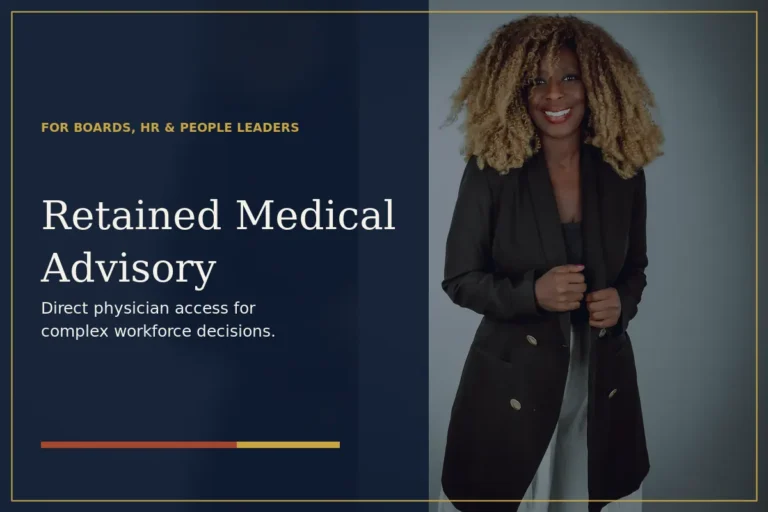
Direct Physician Access
Consistent senior occupational health input for authorised organisational decision-makers.
Continuity Over Time
Ongoing oversight across evolving cases, evidence, rehabilitation and workplace decisions.
Strategic Support
Advice considers occupational medicine, workforce risk and organisational context.
Ongoing Physician-Led Occupational Health Advice
Some workplace health matters cannot be resolved through a single assessment.
Complex cases evolve. New medical evidence emerges. Return-to-work plans need review. Senior leaders may improve, relapse or face changing role demands. HR, legal and leadership teams may also need consistent medical input as organisational risks develop.
Dr Abeyna provides retained, physician-led outsourced occupational health services in London for organisations that require ongoing access to experienced occupational medicine advice.
The service is designed for employers managing sensitive executive health cases, complex workforce health risks and decisions that need continuity rather than isolated reports.
Every suitable retained relationship is overseen directly by Dr Abeyna Jones, a Consultant Occupational Health Physician with nearly two decades of experience.
This is not a high-volume outsourced occupational health department. It is a selective advisory service for organisations that value direct physician access, careful case oversight and commercially aware medical guidance.
Explore Dr Abeyna’s physician-led occupational health advisory practice.
Retained advisory gives authorised decision-makers access to consistent occupational health input over time.
Instead of starting again with a new clinician at each stage, the organisation benefits from continuity. Dr Abeyna develops an informed understanding of the case, the workplace, the leadership structure and the risks surrounding key decisions.
The service may support organisations dealing with:
- Several connected executive health matters
- A prolonged or unpredictable senior leadership absence
- Repeated fitness-for-work questions
- Complex return-to-work planning
- Sensitive capability or performance concerns
- Health risks affecting a high-responsibility role
- Ongoing management referrals
- Workforce health concerns with strategic implications
- Difficult decisions involving medical, legal and operational factors
- The need for regular senior occupational health input
- Limited internal occupational health capability
- A requirement for independent oversight alongside an existing provider
- Retained advisory is built around continuity, judgement and access. It is not a bundle of routine employee appointments.
Discuss Ongoing Occupational Health Support
Submit a confidential application outlining the organisation’s current challenges, the type of advice required and why one-off support may be insufficient.
Why Some Organisations Need More Than One-Off Assessments
A single occupational health assessment answers a defined set of questions at a particular point in time.
That can be enough for a straightforward referral. It may be less useful where the position is changing or several stakeholders need guidance over an extended period.
An organisation may initially need advice on absence. It may later require support with rehabilitation, workplace adjustments, return-to-work timing, review evidence, capability concerns or leadership continuity.
Without consistent oversight, each stage can become disconnected.
Retained support can help preserve a clear clinical thread across:
- Initial referral questions
- Medical assessment
- Rehabilitation planning
- Workplace adjustments
- Interim reviews
- Return-to-work decisions
- Changes in role demands
- Further medical evidence
- Escalation or deterioration
- Longer-term organisational planning
- The objective is not to keep every case open indefinitely. It is to ensure that important workplace health decisions remain coordinated, proportionate and clinically informed.
A Selective Model of Outsourced Occupational Health
Organisations often look for an occupational health provider in London because they need external medical expertise without building a full internal service.
Dr Abeyna offers a more focused model.
The retained advisory service is intended for organisations that need senior physician access for complex, sensitive or strategically important matters. It does not replace a high-volume provider responsible for routine workforce screening, health surveillance or large-scale absence management.
It may be particularly appropriate where:
- Existing occupational health provision is too general
- Senior cases require more experienced clinical oversight
- HR leaders need regular access to an occupational health physician
- Confidentiality must be tightly controlled
- Different reports have created uncertainty
- A case is likely to evolve over several months
- The organisation needs support interpreting medical evidence
- Leadership continuity is at risk
- Workplace health concerns have board-level significance
- A small business needs selective expertise rather than a full outsourced department
- The service can stand alone or complement an existing occupational health arrangement.
Strategic Corporate Occupational Health Services in London
Large organisations may already have internal health, HR, legal and risk functions. Even with these resources, certain cases require a more senior and integrated clinical view.
Dr Abeyna provides retained corporate occupational health services in London for employers that need occupational medicine advice linked to business context.
The work may include:
- Oversight of complex executive health cases
- Review of occupational health recommendations
- Advice on high-risk management referrals
- Support with difficult return-to-work decisions
- Guidance on reasonable workplace adjustments
- Interpretation of medical evidence
- Advice on the occupational implications of health conditions
- Ongoing review of sensitive capability matters
- Escalation planning where health risk is increasing
- Strategic input on workforce health concerns
- Support for boards, HR and legal teams
- Continuity across long-running cases
- Recommendations remain clinically independent. Retained access does not mean providing the employer with a preferred answer.
Complex Case Oversight
Complex cases rarely follow a straight path.
An executive may initially appear ready to return but struggle once responsibilities resume. A medical condition may improve while role demands increase. New treatment may change functional capacity. A proposed adjustment may prove impractical.
Retained oversight enables the occupational health position to be revisited as circumstances develop.
Coordinated Medical Review
Relevant clinical information can be considered in context rather than as isolated updates.
Where appropriate and with the necessary consent, Dr Abeyna may review changes in treatment, prognosis, symptoms or functional capacity.
Continuity Across Decisions
The same occupational health physician remains familiar with the case history, referral questions and organisational concerns.
This reduces repetition and helps maintain consistency.
Review of Workplace Adjustments
Adjustments may need to change over time.
A recommendation that was appropriate during early recovery may no longer be necessary, or it may need to be extended because progress has been slower than expected.
Ongoing Fitness-for-Work Advice
Fitness for work is not always a fixed conclusion.
For demanding leadership or safety-critical roles, it may need periodic review against changing medical evidence and actual workplace performance.
Escalation Where Risk Changes
A retained relationship makes it easier to identify when a matter requires further assessment, additional evidence, legal input or a different management approach.
Workforce Health Risk and Organisational Resilience
Retained occupational health advice can extend beyond an individual case.
Some organisations face broader workforce health risks linked to working patterns, leadership pressure, fatigue, psychological demands or operational intensity.
Dr Abeyna may provide physician-led guidance to help decision-makers think more clearly about the health implications of workplace structures.
Relevant areas may include:
- Patterns of stress-related absence
- Fatigue in high-responsibility teams
- Health risks created by sustained workload
- Recurring return-to-work difficulties
- Leadership behaviours affecting workplace health
- Gaps in management referral processes
- Inconsistent handling of complex cases
- Occupational health risks within organisational change
- Health considerations during restructuring
- Escalation pathways for sensitive cases
- Boundaries between wellbeing support and occupational medicine
- The health implications of safety-critical responsibilities
- This is not a generic wellbeing programme or broad workforce engagement service.
- The focus is on occupational health risk, medical judgement and the decisions required of employers.
Retained Advice for Management Referrals
A management referral occupational health service in London can become difficult to navigate when cases involve unclear questions, conflicting evidence or repeated review.
Retained advisory can help organisations improve both the quality of referrals and the usefulness of the resulting advice.
Support may include:
- Clarifying the purpose of a referral
- Identifying the most relevant occupational questions
- Distinguishing medical issues from management concerns
- Reviewing whether further clinical evidence is required
- Advising on timing for reassessment
- Interpreting work-relevant recommendations
- Supporting consistency across several connected referrals
- Identifying cases that need specialist rather than routine input
- A well-structured referral should ask questions that occupational medicine can reasonably answer.
- It should not be used to transfer a management decision to a doctor.
Occupational Health Support for Small Businesses
Smaller organisations may not need a full occupational health department, but they can still face high-stakes workplace health decisions.
An occupational health assessment for a small business in London may address a single question. Retained support is more suitable where the organisation expects continuing complexity.
This can be relevant where:
- The founder’s health affects business continuity
- A key director has a prolonged absence
- The organisation has limited HR infrastructure
- Several senior cases are being managed at once
- Decision-makers need recurring medical guidance
- A return-to-work plan requires ongoing review
- The business lacks an established referral process
- Health concerns are creating operational risk
- The retained model gives smaller employers access to experienced occupational medicine without requiring a high-volume contract.
What Retained Advisory May Include
The exact scope is agreed after the application has been reviewed.
Depending on the organisation’s needs, retained advisory may include:
Scheduled Advisory Calls
Regular discussions with authorised HR, legal, risk or leadership contacts can help review active cases, emerging concerns and upcoming decisions.
Complex Case Reviews
Dr Abeyna may review the occupational health position in selected cases and advise on the next appropriate step.
Strategic Referral Guidance
Organisations may receive support defining referral questions before an assessment is commissioned.
Review of Medical and Occupational Evidence
Where appropriate and subject to consent and confidentiality requirements, relevant information may be considered to support workplace advice.
Return-to-Work Oversight
Dr Abeyna may provide ongoing input where a senior leader’s return requires review, adjustment or staged progression.
Advice on Workplace Adjustments
Recommendations can be revisited as health, role demands or organisational circumstances change.
Workforce Health Risk Discussions
Authorised decision-makers may seek advice on health risks arising from work design, leadership pressure or operational demands.
Escalation Support
Dr Abeyna may advise when a matter requires a formal assessment, further evidence, specialist input or a different organisational response.
What the Organisation Can Expect
A retained relationship should create clarity rather than dependency.
The organisation can expect:
- Direct physician-led input
- Continuity across complex cases
- Advice grounded in occupational medicine
- Clear distinction between medical and management decisions
- Recommendations informed by workplace realities
- Consistent handling of sensitive information
- Support identifying the right next step
- Greater confidence in difficult health-related decisions
- Earlier recognition of emerging risks
- Better coordination between HR, legal, risk and leadership teams
- A measured approach to leadership continuity
- Advice tailored to the organisation rather than a standard template
- The service does not guarantee a particular clinical, employment or business outcome.
- It provides informed occupational health guidance so the organisation can make its own decisions on a stronger basis.
Benefits of Retained Occupational Health Advisory
For HR and People Leaders
Retained access can reduce the uncertainty that often surrounds difficult health cases.
HR and People leaders may benefit from:
- A consistent senior clinical contact
- Better-framed referral questions
- Help interpreting occupational health advice
- Clearer escalation routes
- Greater confidence managing complex absence
- More structured return-to-work planning
- Support separating medical facts from performance issues
- Reduced reliance on informal or incomplete information
For Boards and Senior Leadership Teams
Health issues involving a key executive can quickly become a continuity and governance concern.
Retained advisory can support:
- More informed leadership risk decisions
- Clearer understanding of functional capacity
- Better coordination of temporary leadership arrangements
- Proportionate review of workplace restrictions
- A more disciplined approach to confidentiality
- Independent input where interests or perspectives differ
For the Individual Executive
Continuity can also benefit the person whose health is being considered.
Potential advantages include:
- Less repetition of sensitive information
- Recommendations informed by the full case history
- Greater consistency across review points
- A more coherent rehabilitation pathway
- Adjustments that evolve with recovery
- Clearer expectations about work and review
Why Organisations Choose Dr Abeyna
Personal Oversight
Every suitable retained relationship is reviewed and managed directly by Dr Abeyna.
There is no transfer between rotating clinicians or a general advice queue.
Consultant Occupational Health Physician
Dr Abeyna Jones is a Consultant Occupational Health Physician with nearly two decades of experience.
Her guidance is grounded in occupational medicine and focused on the practical relationship between health, function and work.
Executive and Organisational Perspective
Leadership health cases can affect governance, operational resilience, stakeholder confidence and business continuity.
Dr Abeyna considers the individual’s health alongside the demands and consequences of the role.
Experience Across Global Organisations
Dr Abeyna has experience consulting with global organisations across different sectors.
This supports advice that is clinically independent while remaining alert to commercial and organisational realities.
Founder of Medic Footprints
Dr Abeyna is the founder of Medic Footprints, a global platform connecting more than 120,000 doctors with national and international companies.
Professional Memberships
Dr Abeyna is a member of the Society of Occupational Medicine and the Faculty of Occupational Medicine.
Selective, Confidential and Highly Personalised
Retained advisory is offered selectively.
The practice is intended for organisations that need thoughtful, direct and ongoing physician involvement—not routine processing of large employee volumes.
Focus on Stability and Continuity
The purpose is to support safe workplace decisions, responsible recovery, leadership stability and organisational continuity.
Apply for a confidential advisory call to discuss ongoing physician-led occupational health support.
The Four-Stage Process
1. Apply Confidentially
Submit a confidential application describing the organisation, the health-related challenges being managed and the type of ongoing support required.
Applications should be made by an authorised organisational decision-maker or professional adviser.
2. Personal Review by Dr Abeyna
Dr Abeyna personally reviews the application.
She considers the complexity of the cases, the expected scope of support and whether a retained relationship is appropriate.
Not every applicant will be accepted.
3. Confidential Advisory Call
Suitable applicants may be invited to a confidential call with Dr Abeyna.
The discussion is used to clarify organisational needs, current risks, active cases and the boundaries of the advisory relationship.
4. Strategic Physician-Led Support
Where retained support is agreed, Dr Abeyna provides ongoing occupational health advice within the defined scope.
This may include complex case oversight, referral guidance, workforce health risk discussions, return-to-work review and strategic recommendations.
Confidentiality in a Retained Relationship
Ongoing access does not reduce the importance of medical confidentiality.
Information about individual employees or executives must still be handled for a legitimate occupational purpose and through an appropriate consent process.
The organisation does not gain unrestricted access to medical details because it has a retained adviser.
Advice should remain focused on work-relevant matters, such as:
- Functional capacity
- Fitness for work
- Workplace restrictions
- Reasonable adjustments
- Return-to-work planning
- Review requirements
- Relevant occupational risks
- The need for further evidence or assessment
- Access to reports and discussions should be limited to those with a legitimate role in the decision.
- Strategic discussions about workforce health risk should also avoid unnecessary disclosure of identifiable medical information.
- Where a matter involves employment law, pension rules, regulation or litigation, the organisation may need separate legal or specialist advice.
Anonymised Case Example
A senior executive stepped away following a significant health crisis.
The organisation faced uncertainty around leadership continuity and whether returning to executive-level work would be realistic.
The case required experienced occupational medicine, executive workplace strategy, rehabilitation support and careful return-to-work planning.
Three months later, the executive returned to the boardroom with greater clarity, confidence and stability.
The example shows how a complex leadership health situation can require several connected forms of support rather than a single isolated opinion.
Individual circumstances vary, and no particular outcome can be guaranteed.
Fees
Fees are discussed after the initial application has been reviewed and will depend on the nature and complexity of the case.
For retained advisory, the proposed scope will reflect the expected level of physician access, case oversight and strategic support.
Apply for Retained Outsourced Occupational Health Services in London
Complex workplace health matters rarely stay static.
Dr Abeyna provides selective, physician-led outsourced occupational health services in London for organisations that need ongoing access to clinical judgement, complex case oversight, workforce health risk advice and strategic support.
This service is designed for employers seeking continuity—not a series of disconnected assessments.
Every application is reviewed personally by Dr Abeyna. Suitable applicants may be invited to a confidential advisory call to discuss the organisation’s needs and whether a retained relationship is appropriate.

Complex Case Oversight
Consistent clinical review as health, role demands and organisational risks change.

Management Referral Guidance
Support defining useful occupational questions and appropriate next steps.

Return-to-Work Oversight
Ongoing review of phased responsibilities, adjustments and recovery.

Workforce Health Risk
Occupational medicine advice for recurring or strategically important health risks.

Evidence & Adjustment Review
Interpretation of medical evidence and review of evolving workplace adjustments.

Leadership Continuity
Physician-led support for safe decisions, organisational resilience and stability.
Frequently Asked Questions
What are retained occupational health advisory services?
Retained advisory provides an organisation with ongoing access to occupational health advice over an agreed period.
It is intended for complex cases, recurring management questions and workforce health risks that require continuity rather than a one-off assessment.
Is this a fully outsourced occupational health department?
No.
Dr Abeyna does not provide a high-volume service for routine employee referrals, health surveillance or general wellbeing delivery.
The retained service offers selective, physician-led support for complex and strategically important matters.
Who is the service designed for?
It is intended for HR Directors, People Directors, Chief People Officers, boards, CEOs, founders, legal and risk professionals, and organisations managing sensitive workplace health issues.
Suitable clients may include FTSE 100 organisations, PE-backed businesses, financial and professional-services firms, high-pressure organisations and smaller businesses with complex needs.
What is the difference between retained advisory and a one-off assessment?
A one-off assessment addresses a defined question at a particular point in time.
Retained advisory provides continuity across evolving cases, repeat decisions, review points and broader workforce health concerns.
Can Dr Abeyna oversee several complex cases?
Potentially, yes.
The scope will depend on the number, nature and complexity of the cases and will be considered after the initial application has been reviewed.
Can the service support management referrals?
Yes.
Dr Abeyna may help clarify referral questions, identify what occupational medicine can reasonably address and advise whether a formal assessment is appropriate.
Does retained advisory include medical assessments?
Assessments may form part of the wider service where agreed and appropriate.
The retained relationship itself is centred on ongoing advice, oversight and strategic support rather than a fixed number of routine appointments.
Can Dr Abeyna advise on workforce health risk?
Yes, where the issue falls within occupational medicine and the agreed scope.
This may include concerns about fatigue, stress-related absence, high-pressure work, recurring return-to-work problems or health risks linked to organisational practices.
Can the service help with executive return to work?
Yes.
Retained support can be useful where a senior leader’s return requires ongoing review, staged responsibilities, adjustments and coordination between several stakeholders.
Can Dr Abeyna work alongside our current occupational health provider?
Yes.
The service may complement existing provision by offering senior physician input, independent oversight or support with exceptional cases.
Is retained advisory suitable for a small business?
It may be.
A smaller organisation may benefit where the health of a founder or key director creates significant continuity risk, or where recurring advice is needed without commissioning a full occupational health service.
Will Dr Abeyna make management decisions for us?
No.
Dr Abeyna provides independent occupational health advice. Employment, operational, legal and governance decisions remain the responsibility of the organisation.
Can our legal advisers join advisory discussions?
Authorised professional advisers may be involved where appropriate and within the agreed scope.
Medical confidentiality and consent requirements still apply.
Does the employer receive full medical details?
No.
Occupational health advice should focus on information relevant to work. The organisation does not automatically receive an individual’s full medical history.
How often can we speak with Dr Abeyna?
The frequency and format of access will depend on the retained scope agreed after the application has been reviewed.
No standard level of availability is promised before that review.
Is the service available outside London?
Dr Abeyna sees suitable clients at her occupational medicine practice in Marylebone, London and supports organisations across the UK.
The suitability and format of retained support will depend on the organisation’s needs.
How much does retained occupational health advisory cost?
Fees are discussed after the initial application has been reviewed and will depend on the nature and complexity of the case.
The proposed arrangement will reflect the anticipated level of access, oversight and strategic input.
How do we begin?
Submit a confidential application explaining the organisation’s current occupational health challenges and why ongoing physician-led support is required.
Suitable applicants may be invited to an advisory call with Dr Abeyna.